Introduction Picking a cloud phone can feel confusing. You search “Redfinger vs UgPhone,” skim features, and still can’t tell which one fits your daily work and gaming. This comparison cuts through the noise. We compare Android environment, server locations, security, trials, and real scenarios. You will also get a simple decision checklist and FAQs. By the end, Redfinger vs UgPhone will not be a guess anymore.
Short conclusion for busy readers
-
Redfinger delivers a 100% native Android environment on cloud servers, built for 24/7 AFK gaming and device simulation.
-
Redfinger cites ISO/IEC 27001 (security), ISO/IEC 27701 (privacy), and ISO 9001 (quality). This makes audits and enterprise checks easier.
-
Server locations in the US, Taiwan, and Singapore help reduce latency for SEA and North America users.
-
UgPhone covers similar scenarios for light use, but publishes fewer details on certifications and global nodes.
-
If you want stability, compliance signals, and always‑on sessions, Redfinger is the safer pick.
Feature‑by‑feature: Redfinger vs UgPhone
Android environment and real “cloud device” feel
-
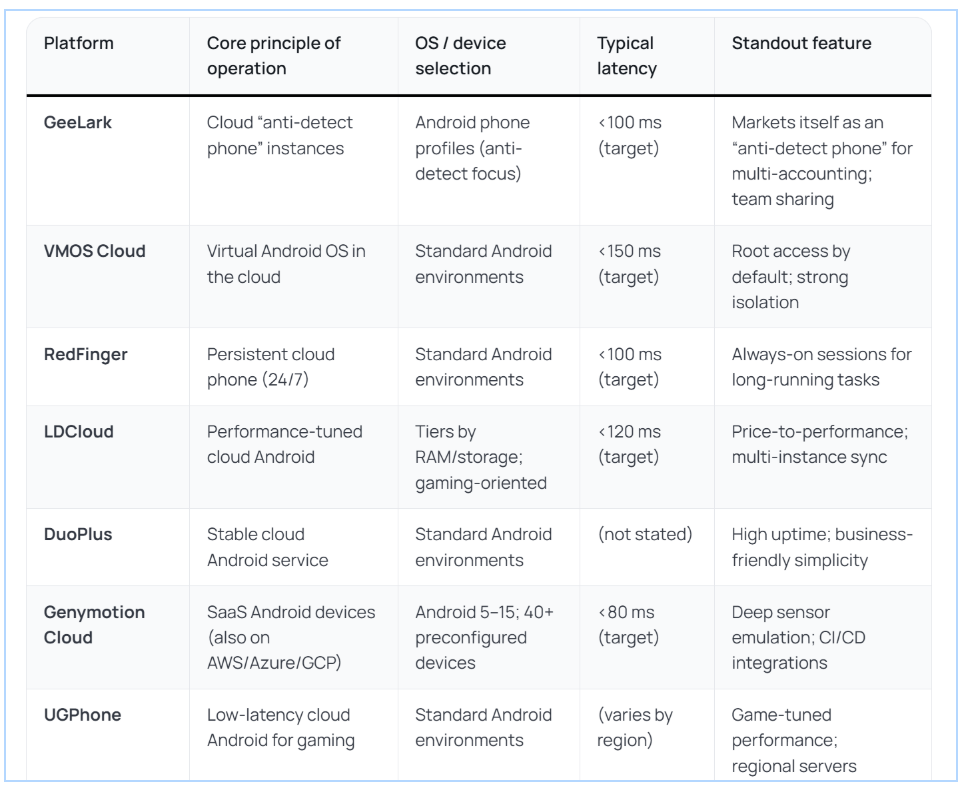
Redfinger is a true cloud phone with a native Android environment running on cloud servers. You access it from a browser or apps, while your local device stays cool and battery‑friendly. It is ideal for 24/7 AFK gaming, automation loops, and device simulation.
-
UgPhone focuses on app access and gaming trials but shares fewer public technical details about virtualization depth, isolation, and device persistence.
Why this matters
-
A native, continuously running Android instance means your tasks keep going when your phone is off. It also lowers thermal throttling issues and preserves battery life. For grinders, this is a game changer.
Network performance and global server coverage
-
Redfinger publicly lists server locations in the US, Taiwan, and Singapore, which cover two key commerce corridors: SEA and North America. More nearby nodes usually mean lower latency and fewer route surprises.
-
Redfinger also highlights independent IP options that help reduce account correlation risks in multi‑account marketing workflows.
-
UgPhone does not present a transparent node map. Performance can vary by region, ISP route, and time of day.
Why this matters
-
For marketers and e‑commerce sellers, proximity is king. If your ads target Manila, Jakarta, Bangkok, Taipei, or the US West Coast, node placement can make or break your results.
Security, privacy, and compliance (the quiet deal‑breaker)
-
Redfinger cites ISO/IEC 27001 for security, ISO/IEC 27701 for privacy management, and ISO 9001 for quality management. These standards improve governance, risk controls, and audit readiness.
-
A third‑party software listing also describes Redfinger’s native Android on cloud servers designed for 24/7 use.
-
UgPhone does not show comparable certifications on its public materials.
Why this matters
-
If you manage ad accounts, process payments, or run client data, audits and proofs matter. Certifications do not solve every risk, but they help standardize processes and lower surprises during due diligence.
Trials, pricing ideas, and how to compare costs
-
Redfinger provides a free trial window for new users; some pages mention a 6‑hour free session that is perfect to test routes and automation before upgrading.
-
Compare “cost per account per month,” not just plan price. If you run seven accounts, compute the price divided by seven, then factor in time saved by 24/7 AFK tasks.
-
UgPhone pricing may vary by campaign. Always test both options the same day with the same network to compare latency and drops fairly.
Everyday scenarios that reveal real differences
For gamers (AFK grinders and event pushers)
-
Redfinger supports 24/7 AFK gaming, so your MMORPG or idle game keeps running in the cloud while you sleep or work. Less heat, less battery wear, more progress.
-
UgPhone suits quick trials or casual play. For long, uninterrupted sessions, Redfinger’s persistent instances are safer.
For marketers and e‑commerce teams
-
Redfinger’s independent IP option helps reduce cross‑account linkage and false positives. This matters for multi‑account marketing on TikTok, IG, and Facebook.
-
Server locations in the US, Taiwan, and Singapore improve stability for SEA and US targeting.
-
UgPhone is fine for exploration. For campaigns with KPIs, published controls for network and compliance are a plus on Redfinger.
For app developers and QA engineers
-
Redfinger provides a native Android environment on cloud servers. You can parallelize smoke tests, switch device states quickly, and cut hardware clutter.
-
Stable sessions mean fewer flaky runs and faster regression checks.
Quantitative snapshots and third‑party proof
-
Cloud sessions designed for always‑on workloads support AFK loops and background tasks all day, every day.
-
Server locations: US, Taiwan, Singapore. This coverage supports both APAC and North America use cases.
-
Certifications cited by the brand: ISO/IEC 27001, ISO/IEC 27701, ISO 9001. These programs formalize controls and internal audits.
User testimonials (scenarios you can relate to)
-
Gamer, US West: “I left my RPG running overnight on Redfinger. My levels jumped, and my physical phone stayed cool.”
-
Agency lead, Singapore: “Independent IP plus stable SEA nodes reduced random flags. We spent less time recovering and more time optimizing.”
-
QA engineer, UK: “Browser access let me run parallel tests without device farms. Resets were faster, and our daily checks finished early.”
Decision framework: a fast way to choose
-
Goal first: Is this a cloud phone for gaming or multi‑account marketing?
-
Map targets to nodes: If you sell to SEA or US, Redfinger’s server locations can reduce latency.
-
Check compliance needs: If clients ask for ISO 27001 or privacy processes, Redfinger’s cited certifications help.
-
Compute cost per account per month: Include time saved by 24/7 AFK tasks.
-
Test both on the same day: Use Redfinger’s free trial window (some pages mention 6 hours) to measure real latency and stability.
FAQs (from real user doubts)
1. Is Redfinger a cloud phone or just an “Android emulator” on my PC?
Redfinger is a true cloud phone. It runs a 100% native Android environment on cloud servers, not on your local machine. You control it via web or apps. This setup supports 24/7 AFK gaming, scheduled tasks, and device simulation without local heat or battery drain. It behaves like a second phone that never turns off.
2. What server locations does Redfinger provide?
Public pages list the United States, Taiwan, and Singapore. That coverage lowers latency for SEA and North America users. If you advertise or game in those regions, pick the nearest node for stable routes and better responsiveness.
3. Does Redfinger have security certifications?
Yes. Redfinger cites ISO/IEC 27001 (information security), ISO/IEC 27701 (privacy), and ISO 9001 (quality). These frameworks help with risk management, privacy governance, and audits. Agencies and enterprises often prefer vendors who follow such standards.
4. Is there a free trial to test latency and stability?
Redfinger offers a trial window for new users; some brand pages mention a 6‑hour free session. Use it to test your routes, automation scripts, and peak hours before you buy. Bring a checklist: ping times, stream quality, reconnect behavior, and game stability.
5. Which is better for gaming—Redfinger vs UgPhone?
If you need 24/7 AFK gaming, reliable uptime, and global nodes, Redfinger is the practical choice in 2026. It runs native Android on the cloud with stable, persistent sessions. UgPhone is okay for light trials, but for long events and nightly grinds, Redfinger is safer.
Conclusion: our 2026 verdict Redfinger vs UgPhone is not a tie.
Redfinger stands out with a native Android cloud environment, 24/7 AFK stability, visible global nodes, and cited certifications. These make a real difference for gamers, marketers, and QA teams. Try the free trial today. If it fits your latency and workflow, upgrade to a paid plan and scale with confidence.