Introduction Choosing between cloud phones can feel hard. You see features everywhere. You still cannot tell which fits your daily tasks. This Redfinger vs LDCloud guide focuses on what matters. We compare Android environment, server coverage, security, pricing logic, and real use cases. You also get a simple decision checklist and FAQs. Our goal is clarity, not hype.
-
Redfinger provides a native Android environment that runs 24/7 on cloud servers. It supports always-on sessions for gaming and automation. It also cites ISO/IEC 27001, ISO/IEC 27701, and ISO 9001 certifications.
-
LDCloud lets you access Android apps and games from almost any device with a stable connection. It is popular with gamers who want larger screens and flexible access.
What Both Platforms(Redfinger vs LDCloud) Do?
Both services stream an Android environment from the cloud. You can log in on a PC, iOS, or a web browser. You can run apps without a local Android phone. LDCloud emphasizes quick access and cross-device flexibility.
Redfinger focuses on persistent cloud devices for 24/7 AFK gaming and device simulation.
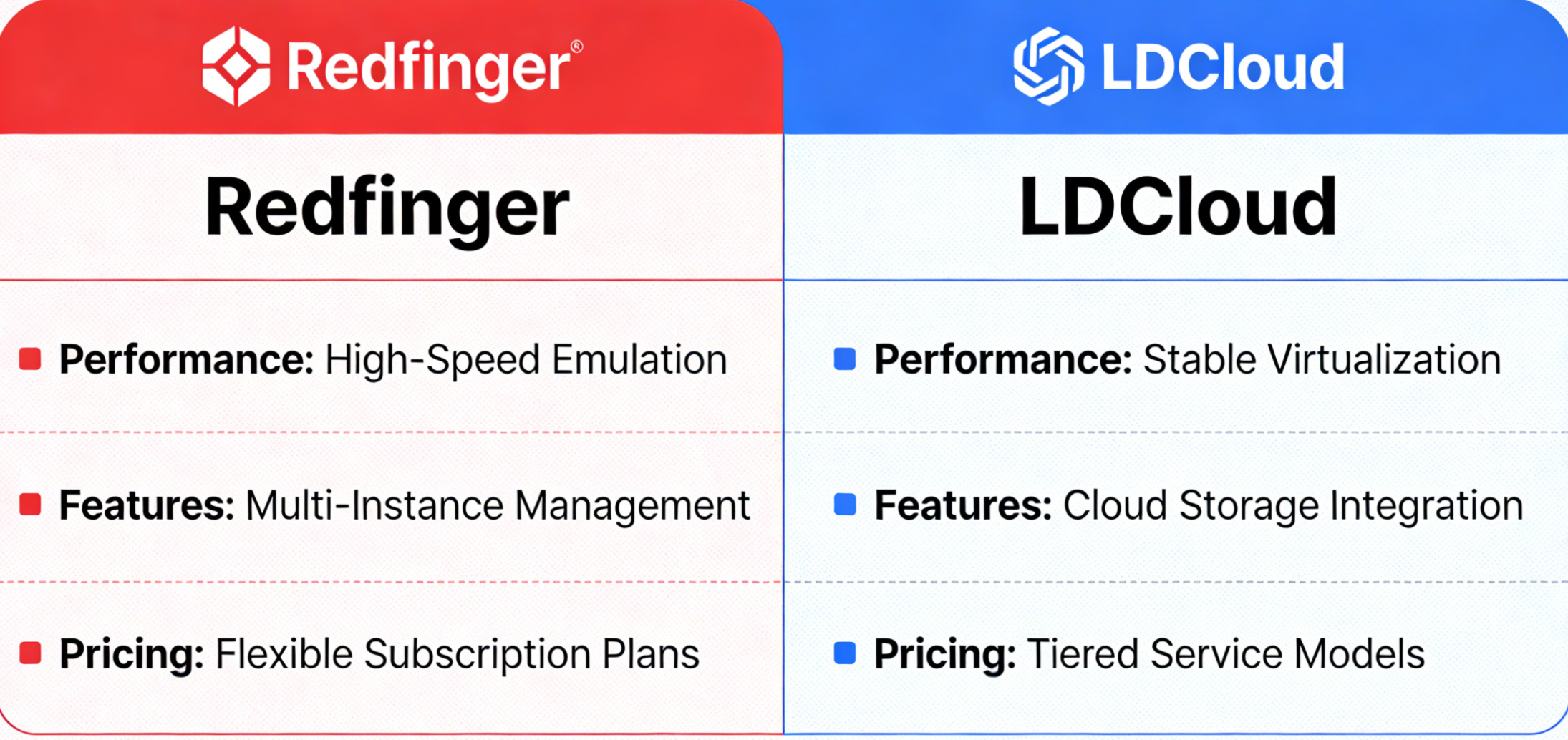
Key Differences at a Glance(Redfinger vs LDCloud)
-
Android depth and persistence: Redfinger runs a true cloud Android instance that keeps running after you log out. This helps AFK loops and automation.
-
Server transparency: Redfinger publicly highlights server locations in the US, Taiwan, and Singapore. That benefits SEA and North America users.
-
Security posture: Redfinger cites ISO/IEC 27001, ISO/IEC 27701, and ISO 9001. These standards support governance and audits.
-
Independent IP options: Redfinger mentions independent IP to reduce account correlation risk. This helps marketers with multi-account workflows.
-
Ease of access: LDCloud spotlights simple login, web access, and a free trial to start.
1 — Android Environment and “Always-On” Persistence
Redfinger’s native cloud
Android Redfinger provides a native Android environment designed for continuous use. Your tasks keep running when your local device is offline. This is ideal for 24/7 AFK gaming, macros, and scheduled jobs.
LDCloud’s flexible app access
LDCloud helps you run Android apps from the cloud on many devices. It is friendly for users who want quick access and a bigger screen experience.
Why this matters A persistent cloud Android saves battery life on your real phone. It reduces thermal throttling and keeps sessions online overnight. That is a strong edge for grinders and automation users.
2 — Network and Server Coverage
Redfinger lists US, Taiwan, and Singapore locations. These nodes shorten routes for SEA and North America. This placement can help ad delivery and game latency.
Independent IP options also reduce account linking risks. That matters for agencies and sellers managing multiple brands. LDCloud focuses on accessibility and multi-device use. It is a practical LDCloud alternative approach when flexibility is your top need.
3 — Security, Privacy, and Compliance
Security can be a quiet deal-breaker. Redfinger cites ISO/IEC 27001 for security, ISO/IEC 27701 for privacy, and ISO 9001 for quality management. These standards help with risk controls and audits. They also send strong compliance signals to enterprise teams. A third-party listing also describes Redfinger’s design for 24/7 use cases.
Pricing Logic and Total Cost of Ownership
Public prices change by region and plan. So focus on cost per account and required features. LDCloud highlights easy start and a free trial path. This can lower test costs for small teams.
Redfinger’s persistent devices and independent IP can reduce hidden costs. Think about fewer session drops and less manual relogin time. These factors shape long-term ROI.
Use Cases That Shape Your Choice
Gamers and creators
-
Need 24/7 AFK gaming with stable loops? Redfinger’s persistent cloud Android is a fit.
-
Want quick access and big-screen play on various devices? LDCloud makes that easy.
-
Try phrasing in searches like “cloud phone for gaming” to compare practical tips from communities.
Marketers and e-commerce teams
-
Running multi-account campaigns across markets? Independent IP and stable sessions help. Redfinger highlights these needs.
-
Testing flows fast with a low barrier? LDCloud’s login and trial flow can help teams prototype early.
Developers and QA
-
Need a persistent sandbox with predictable behavior? Redfinger’s native cloud Android supports long-running jobs.
-
Need quick device access to validate UI on a big screen? LDCloud offers easy cross-device entry.
Real Users, Real Scenarios
-
Gamer perspective: “I farm overnight without leaving my phone plugged in. My 24/7 AFK gaming continues in Redfinger even when my laptop sleeps.”
-
Marketer perspective: “Our team runs multiple accounts daily. Independent IP and steady sessions cut relogin time and reduce account flags.”
-
Entrepreneur perspective: “LDCloud’s easy web access helped the team test flows quickly during a launch week.”
FAQs of Redfinger or LDCloud
Q1: Which is better for 24/7 AFK gaming, Redfinger or LDCloud?
A1: Redfinger is built for persistent cloud Android sessions that keep running when you go offline. This design suits 24/7 AFK gaming and automation loops. LDCloud is convenient for multi-device access and trials, but Redfinger’s persistence is the key edge for grinders.
Q2: Does Redfinger offer global servers to reduce latency?
A2: Yes. Redfinger highlights server locations in the US, Taiwan, and Singapore. That coverage benefits SEA and North America. Nearby nodes usually mean lower delay and fewer routing surprises. Marketers also benefit when delivering ads in these corridors.
Q3: Why do ISO certifications matter for a cloud phone?
A3: ISO/IEC 27001 and 27701 improve security and privacy governance. ISO 9001 supports quality management and repeatable processes. Together, they make vendor audits easier and signal enterprise readiness. Redfinger cites all three certifications.
Q4: Is LDCloud a good option for quick tests or casual play?
A4: Yes. LDCloud emphasizes easy login, a web interface, and a free trial path. It is helpful for quick validation and big-screen gaming tests. If you later need persistent sessions, compare Redfinger for native, always-on cloud devices.
Q5: Can a cloud phone help with multi-account marketing?
A5: Yes. Persistent sessions and independent IP options reduce correlation risks and manual relogin work. Redfinger highlights both capabilities for marketers and e-commerce sellers. Test your workflow first, then compare cost per account.
Conclusion
Redfinger vs LDCloud is not a close call if you need stability, compliance, and 24/7 persistence. Redfinger’s native cloud Android, visible ISO certifications, and listed server regions make it a reliable long-term pick. Start now and experience always-on sessions in minutes with Redfinger cloud phone.